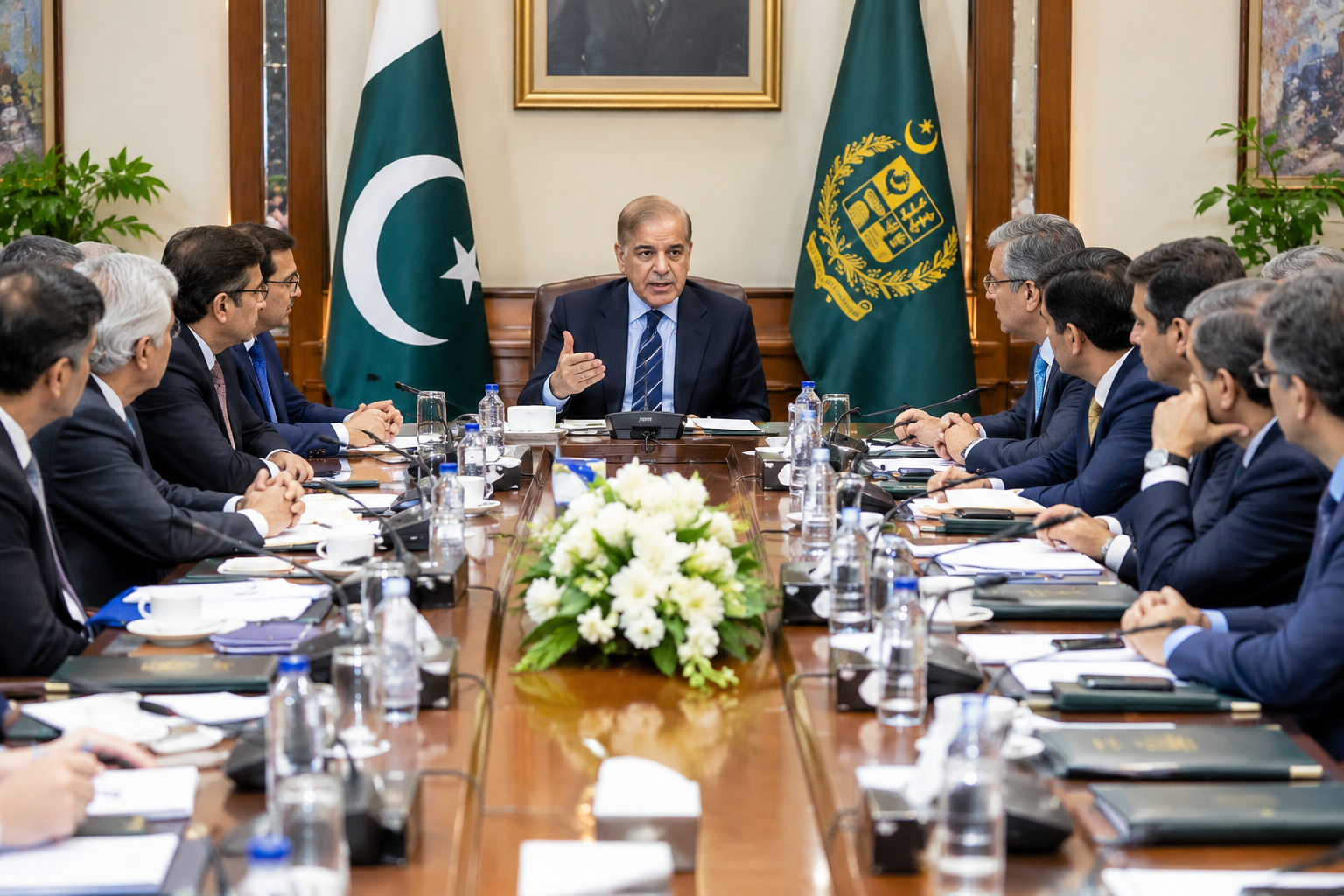
Prime Minister Shehbaz Sharif has directed authorities to take immediate and effective measures to address the concerns of Pakistan’s business community and ensure timely, lasting solutions to their grievances.
During a meeting with leading industrialists and business leaders, the prime minister also instructed tax authorities to review a proposal seeking a super tax exemption for exporters with less than 80% of their export proceeds.
The business delegation presented recommendations covering taxation, energy costs, trade, regulations, industrial activity and the overall ease of doing business. Prime Minister Shehbaz welcomed the proposals and reaffirmed the government’s commitment to working closely with the private sector to boost exports and strengthen economic growth.
The prime minister said reducing energy costs remains a key government priority, while efforts are also underway to improve the business environment. He highlighted the role of the Trade Facilitation Board (TFB) and invited business leaders to suggest measures to strengthen its effectiveness.
He also noted that the Special Investment Facilitation Council (SIFC) provides investors with a one-window platform to facilitate investment and address administrative hurdles. Meanwhile, the government is working on a regulatory “guillotine” to remove unnecessary regulations, simplify procedures and lower compliance costs for businesses.
Sharif highlighted progress in the digitisation of the Federal Board of Revenue (FBR), noting that Rs800 billion was collected through enforcement during the last fiscal year. He said Pakistan’s macroeconomic conditions had improved significantly but stressed the need for further reforms at the microeconomic level so that economic stability translates into broader public benefits.
The prime minister also called for greater alignment between workforce training and industry requirements, particularly as market demand continues to evolve.
Officials briefed business leaders on initiatives to improve trade infrastructure and reduce transportation bottlenecks. These include lower port charges, improved port capacity, the planned upgrade of Motorway M-10 and the Pipri Freight Corridor, construction of Motorway M-13 between Kharian and Rawalpindi, and efforts to modernise Pakistan Railways’ freight infrastructure.
The government also highlighted growth in IT exports and said one million people are being trained in information technology and artificial intelligence to strengthen Pakistan’s digital workforce. Measures are also being introduced to support small and medium-sized enterprises (SMEs), particularly by improving access to financing and helping them enter export markets.
Business leaders welcomed improved macroeconomic stability and praised government initiatives including the Export Development Fund, timely tax refunds, FBR digitisation and the successful issuance of a $3 billion bond. They expressed support for export-led growth, privatisation and deregulation while also raising sector-specific concerns and proposing solutions for their respective industries.
The meeting was attended by prominent business figures, including Mian Muhammad Mansha, Arif Habib, Saqib Shirazi, Atif Bajwa, Muhammad Ali Tabba, Musaddiq Zulqarnain, Samad Dawood and other leading industrialists and business representatives.