Menu

Latest News

Pakistan’s 5G Revolution
Pakistan has successfully auctioned 480 MHz of new spectrum, doubling its capacity and laying the foundation for 5G. With Jazz leading the investment and Ufone grabbing 5G capacity, the country is no longer a regional laggard. The focus now shifts to upgrading fiber infrastructure and making 5G devices affordable for the masses.
Read more
Pakistan Mobile Phone Imports Experience 30% Surge to $1.3 Billion in FY26
Pakistan’s mobile phone imports surged by 29.6% to reach $1.295 billion during the first eight months of the 2025–26 fiscal year. While this represents a significant recovery from the previous year’s decline, domestic manufacturing is simultaneously hitting new heights, with local plants producing 30.21 million handsets in 2025—dwarfing the number of finished units brought in commercially. The data highlights a clear shift in the country's tech landscape, as smartphones now make up 71% of the devices on the national network. Despite a minor month-on-month dip in February, the overall trend points toward a rapidly digitizing economy supported by both a rebound in high-value imports and a robust local assembly sector.
Read more
Pakistan Targets Fuel Crisis with 4-Day Work Week and Radical Austerity Measures
In response to soaring global oil prices triggered by regional tensions, Prime Minister Shehbaz Sharif has launched a nationwide "war austerity plan." The initiative targets massive fuel and fiscal savings by shifting the country to a four-day work week and a 50% work-from-home model for both public and private sectors (excluding banks and essential services). Additional measures include a 50% cut in government fuel quotas, grounding 60% of the official fleet, and significant salary deductions for cabinet members, lawmakers, and high-ranking officials. To further reduce overhead, the government has banned hotel-based events and foreign travel, while closing schools from March 10 to 31 in favor of online learning. These combined efforts are projected to save the national exchequer over PKR 26 billion.
Read more
Punjab to Combat Urban Flooding with 67 Rainwater Storage Tanks Across 52 Cities
The Punjab government has launched a major project to build 67 underground rainwater storage tanks across 52 cities to combat urban flooding and enhance water security. Part of the Punjab Development Programme (PDP), the initiative targets flood-prone areas like Kamoke (19 tanks), Kot Abdul Malik (14), and Ferozewala (14), drawing inspiration from efficient international water management models. Officials have directed that construction be completed before the upcoming monsoon season to provide immediate relief to cities vulnerable to waterlogging.
Read more
Pakistan Hits Rs8.1 Trillion Tax Milestone Amid Economic Revival
Pakistan’s economy is showing strong recovery signs as tax revenue reached Rs8.1 trillion in the first eight months of FY2025–26, up from Rs7.3 trillion last year. This growth is supported by a 4.8% rebound in Large-Scale Manufacturing led by a massive 67.2% spike in the automobile sector and a 11.3% increase in remittances, which hit $23.2 billion. On the trade front, ICT exports surged by 20%, helping drive services exports to $5.7 billion. While February inflation rose to 7% due to energy tariff adjustments, the cost of essential food items like eggs, chicken, and potatoes has actually dropped significantly. Planning Minister Ahsan Iqbal credited these gains to better tax compliance and increased development spending, though he warned that global energy volatility and Middle East tensions remain key risks to long-term stability.
Read more
Pakistan Fuels Crisis as Petrol and Diesel Skyrocket by Rs55 Per Litre
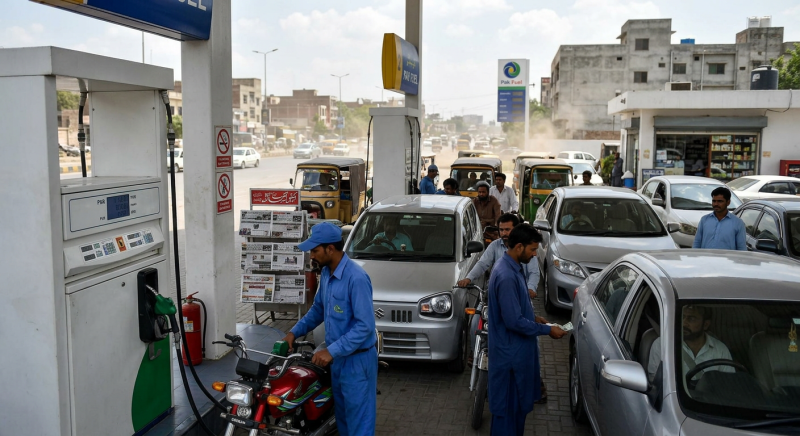
The Pakistani government has announced a massive Rs55 per litre increase for both petrol and diesel, effective from midnight on Friday. This record hike brings petrol to Rs321.17 and diesel to Rs335.86 per litre, a decision driven by skyrocketing global oil prices following the escalation of conflict between Iran, the US, and Israel. Government officials, including Finance Minister Muhammad Aurangzeb and Deputy PM Ishaq Dar, noted that the regional instability has caused Brent crude to surge above $90 a barrel. In response to the crisis, Prime Minister Shehbaz Sharif has ordered an immediate nationwide crackdown on fuel hoarding and the cancellation of licenses for stations creating artificial shortages.
Read more
UAE Property Market Faces Major Crisis as Regional Conflict Shakes Investor Confidence
The UAE’s real estate market is grappling with a sudden instability after Iranian missile strikes challenged its status as a global "safe haven." This geopolitical shift has caused a sharp drop in developer stocks (down 5%), a freeze in the bond market, and serious concerns over the 300,000–400,000 new units expected by 2028. With 65% of Dubai's market tied to off-plan sales and a 90% expatriate population, the sector’s future now rests on whether foreign investors still view the region as a secure place for their capital.
Read more
South Korea Fears Middle East Conflict Could Stifle Global Chip Supply
South Korea is warning that the intensifying conflict involving Iran, Israel, and the U.S. could disrupt the global semiconductor supply chain. The crisis threatens the sourcing of helium, a critical material with no viable alternatives used for heat management in chip production. While major players like SK Hynix report sufficient current inventories, industry leaders fear that prolonged regional instability will lead to higher energy costs and stall Big Tech’s expansion of AI data centers in the Middle East. This warning comes as drone strikes have already damaged Amazon data centers in the UAE and Bahrain, raising concerns for companies like Microsoft and Nvidia that view the region as a future hub for AI computing.
Read more
The Slowdown of Pakistan’s Solar Momentum
The government’s transition from net metering to a more restrictive net billing system under the Prosumer Regulations 2026 has fundamentally altered the economics of solar energy in Pakistan. By forcing consumers to sell excess electricity back to the grid at significantly lower rates than they pay to import it, the new policy has drastically extended the payback period for solar investments and cooled a market that was previously the fourth largest in the world for solar imports. This slowdown poses a direct threat to Pakistan’s $100 billion export target, as industries particularly textiles urgently need cheap, green energy to comply with the European Union’s upcoming carbon taxes and remain competitive against regional rivals. Consequently, as policy uncertainty drives a sharp decline in solar panel imports, the market is shifting toward smaller, self-sufficient systems and increased battery storage, leaving the country to weigh the short-term goal of protecting grid revenue against the long-term necessity of a sustainable energy transition.
Read more