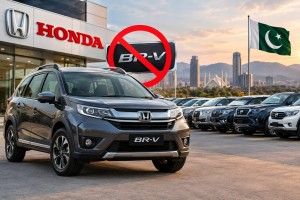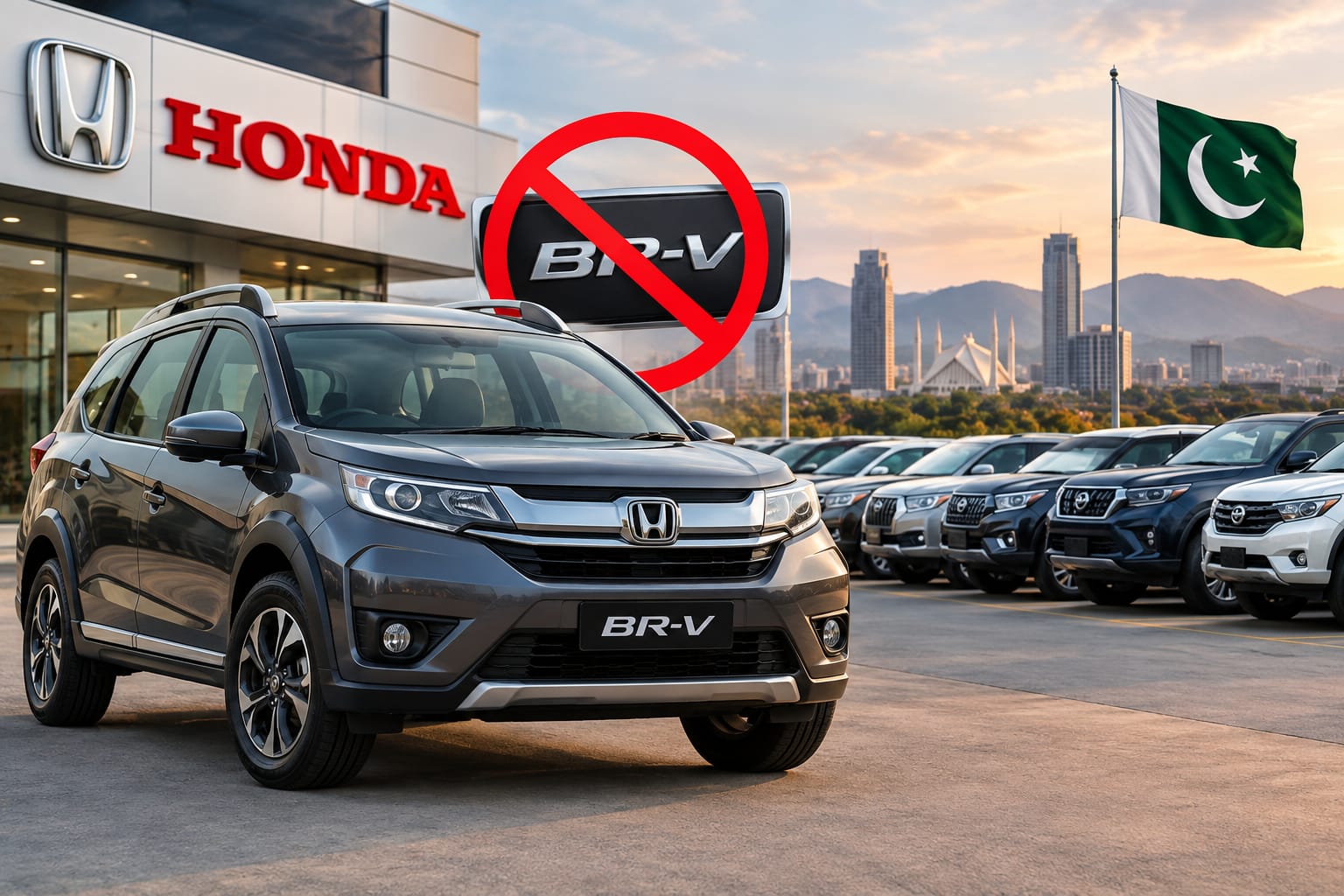
Honda Atlas Cars Pakistan Ltd has discontinued production of the Honda BR-V, bringing an end to the seven-seat crossover’s nearly nine-year run in Pakistan at a time when the country’s SUV and crossover market is expanding rapidly.
Launched in April 2017, the BR-V was positioned as a relatively affordable alternative to larger SUVs such as the Toyota Fortuner. It offered three rows of seating, a 1.5-litre engine and locally assembled production, initially priced at around Rs2.2–2.3 million. Honda sold 7,318 BR-V units during its first year, giving the model a strong start.
However, Honda has now informed the Pakistan Stock Exchange that it has discontinued production of the BR-V. A company official said the decision was not linked to supply shortages and that imported components remained available. Instead, the model had reached the end of its product lifecycle. Production had reportedly declined to around 25–50 units per month, and Honda has not announced a direct replacement.
The BR-V’s exit is particularly notable because Pakistan’s automobile market has shifted dramatically toward SUVs and crossovers since its launch. The arrival of models such as the Kia Sportage and Hyundai Tucson helped accelerate consumer interest in higher-riding vehicles, while Chinese automakers further intensified competition.
Kia’s Sportage became one of the market’s major crossover success stories, while Hyundai’s Tucson also established a strong presence. Chinese brands including Haval, Changan, MG, Chery and Jetour subsequently expanded consumer choice with vehicles offering features such as panoramic roofs, advanced driver-assistance systems, turbocharged engines and hybrid powertrains.
Haval has emerged as a particularly strong competitor. Its sales increased from 5,319 units in FY2024 to 10,783 in FY2025, highlighting the growing appetite for modern SUVs in Pakistan.
The market is also entering a new phase with the arrival of electric and hybrid vehicles. BYD has expanded its presence in Pakistan with models including the Atto 2, Atto 3, Seal, Sealion 7 and Shark 6, while plans for local new-energy vehicle assembly are expected to further increase competition.
At the same time, established Japanese and Korean automakers are also moving toward electrified crossovers. Kia, Haval and Hyundai have introduced hybrid options, while Honda continues to offer the newer HR-V, including an electrified variant.
The discontinuation of the BR-V does not necessarily indicate weakness for Honda Atlas. The company’s overall performance improved significantly in FY2026, with 28,015 vehicles sold during the year—a four-year high and a 53% increase from FY2025. The City and Civic remain important products for the company, while the HR-V gives Honda a more modern presence in the crossover segment.
The BR-V’s departure instead reflects how dramatically Pakistan’s automobile market has evolved since 2017. What was once a relatively unique combination of local assembly, seven seats and SUV styling has become a highly competitive segment filled with newer petrol, turbo, hybrid, plug-in hybrid and electric vehicles.
The BR-V helped anticipate Pakistan’s shift toward SUVs and crossovers. However, as the market embraced that trend, newer and more technologically advanced competitors ultimately left the ageing model behind.