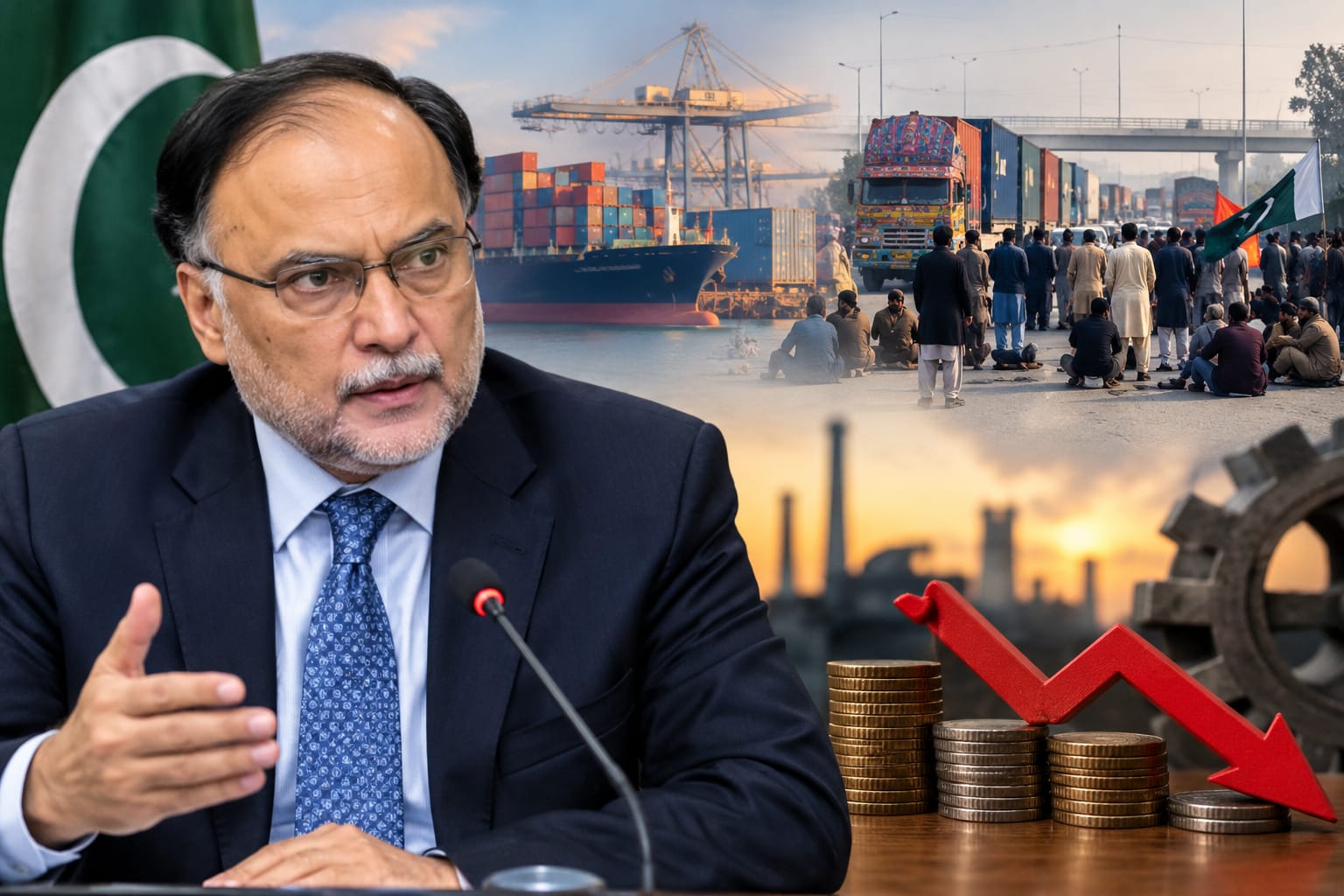
Finance Minister Muhammad Aurangzeb has warned that long marches, sit-ins, strikes and road blockages could cause an estimated Rs120 billion in daily losses to Pakistan’s economy. He said disruptions to business and economic activity could undermine the country’s recent progress from economic stabilisation towards sustainable growth.
According to Aurangzeb, the government, in coordination with the Planning Commission’s economic wing, assessed the potential impact of large-scale protests based on previous disruptions and current economic conditions. The services sector could face the largest impact, with estimated losses of Rs86 billion per day across financial services, communications, transport, retail, wholesale and hospitality.
The industrial sector could suffer around Rs25 billion in daily losses, affecting construction, manufacturing, raw materials and supply chains, while agriculture could face an additional Rs9 billion in losses through disruptions to transportation, perishable goods, dairy, agricultural trade and related supply chains.
Aurangzeb also estimated that disruptions could result in around Rs17 billion in daily government revenue losses as economic activity and business operations are affected.
His remarks came after Jamaat-e-Islami (JI), Kissan Ittehad and Pakistan Tehreek-e-Insaf (PTI) announced plans for long marches towards Islamabad over separate demands. JI was seeking changes to the petroleum development levy, Kissan Ittehad was calling for relief for farmers, while PTI was demanding the release of its founder Imran Khan.
The finance minister said Pakistan had recently moved towards economic recovery after a period of contraction, with GDP growth reaching 3.7% last year. He said the government expected growth to exceed 4% this year, supported by improvements in large-scale manufacturing, corporate activity, investment and capital-market participation.
Aurangzeb said Pakistan’s future growth should increasingly depend on exports while avoiding previous boom-and-bust economic cycles. The government has set a $32.9 billion goods export target for the year, while daily goods exports are estimated at around $90 million.
He cautioned that domestic disruptions could further pressure exporters already facing higher freight and insurance costs due to supply-chain challenges in the Gulf region and around Bab el-Mandeb.
The finance minister said the impact of prolonged disruptions would extend beyond headline economic figures, affecting daily wage workers, small businesses, shopkeepers and ordinary consumers. He also noted that large-scale protests could generate additional costs related to security deployments, transport, logistics and fuel.
Aurangzeb further highlighted the importance of economic stability for attracting investment, noting that foreign direct investment reached $311 million in August. He said continued economic stability, stronger domestic investor confidence and increased foreign investment were important components of Pakistan’s transition towards sustainable growth.
He urged political and other stakeholders to resolve their differences through dialogue and avoid disruptions that could affect economic activity. Aurangzeb said maintaining economic stability and continuing the country’s transition towards growth should remain a shared responsibility.