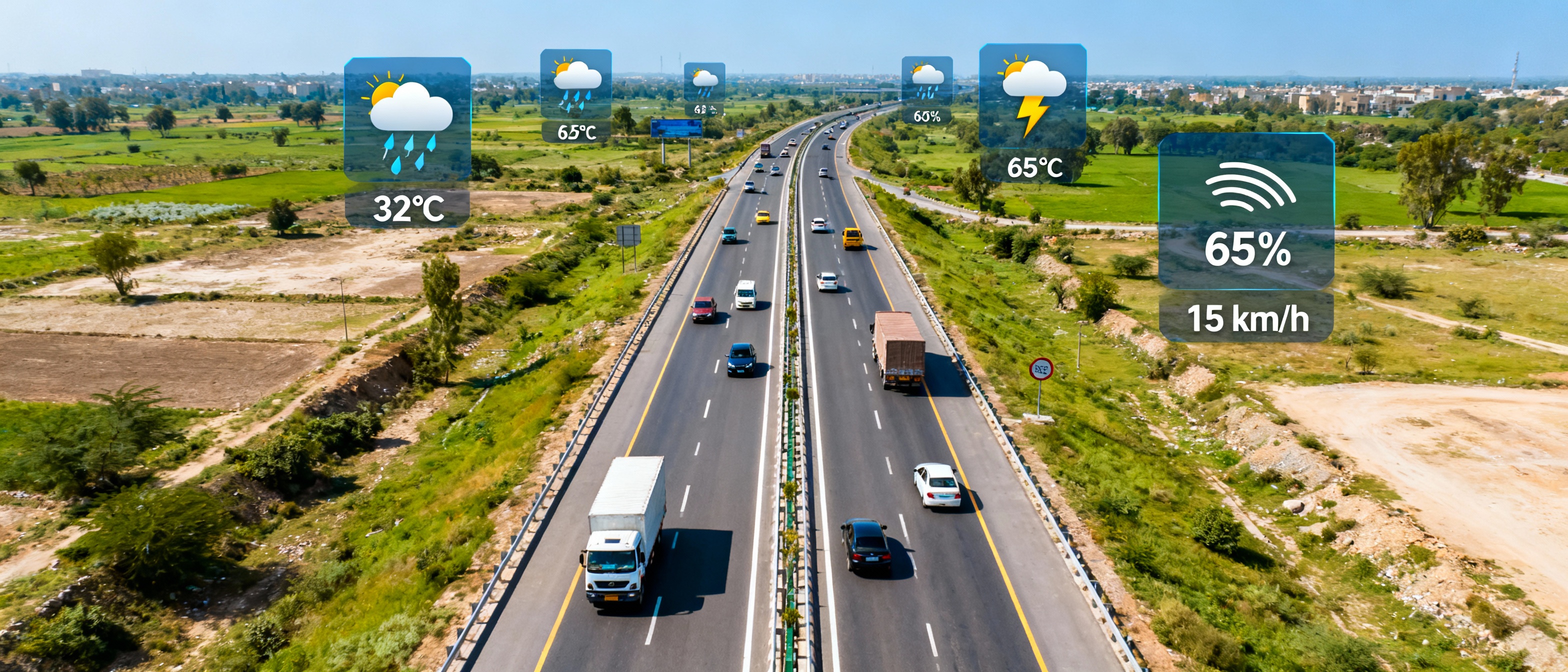
Pakistan's government is set to implement a cutting-edge weather alert system on the Islamabad–Lahore Motorway (M2) via the "Weather on the Way" program. This pioneering collaboration between WeatherWalay and ONE Network introduces hyperlocal weather monitoring to a vital 375-kilometer route that handles millions of vehicles annually across diverse microclimates.
The system equips drivers with accurate, real-time data to navigate hazards like fog, rain, and high winds, reducing accident risks on this high-traffic corridor. It integrates 14 automated weather stations for temperature and precipitation tracking, 5 air quality monitors to detect pollution levels, and 4 visibility sensors to gauge road conditions during low-light scenarios. Satellite imagery and predictive forecasts feed into a central engine that analyzes threats, delivering alerts via mobile apps, online portals, and LED screens at key toll points.
This deployment elevates Pakistan's infrastructure safety standards, aligning with global practices that emphasize verified, on-ground data for traffic control and emergency response. Agencies like the National Highway and Motorway Police (NH&MP) and National Disaster Management Authority (NDMA) will leverage the unified data stream for proactive planning, including fog-prone area management.
Beyond transportation, the network's dense sensor array supports broader applications such as precision agriculture through irrigation timing, environmental surveillance for health risks like dengue outbreaks, and urban planning in variable terrains. WeatherWalay's nationwide efforts, blending international models with local adaptations, already aid sectors from energy forecasting to tourism, while fostering academic partnerships for climate research in regions like Islamabad's microclimate hotspots.
Overall, "Weather on the Way" advances Pakistan's resilience against climate challenges, promoting safer travel and data-driven decisions for public and private stakeholders alike.